Arrays vs Linked Lists: When to Use Each
Master arrays vs linked lists by understanding their core trade-offs for efficient data management in your programs.
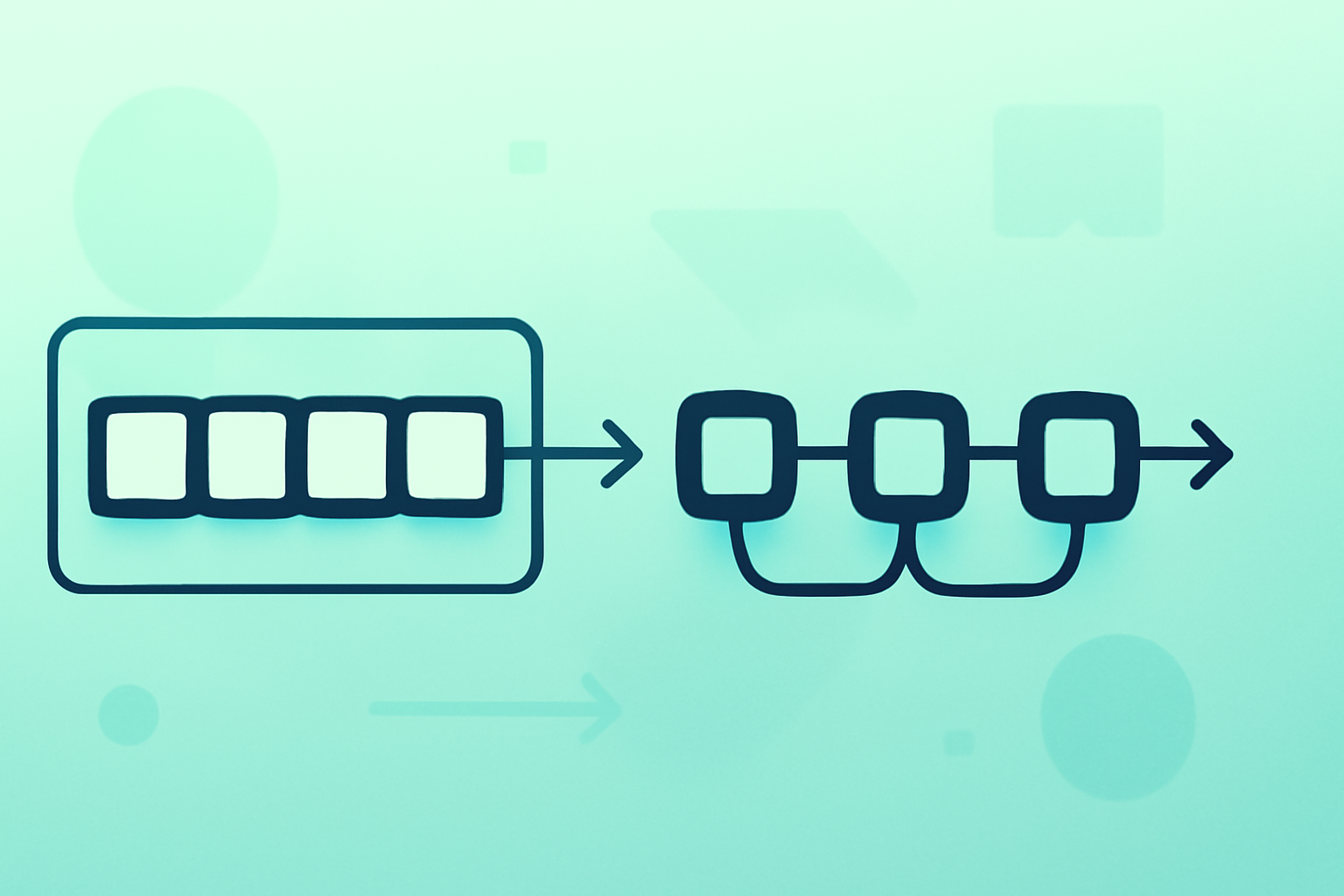
When you're building software, choosing the right data structure can dramatically affect your program's performance. Two fundamental building blocks you'll encounter frequently are arrays and linked lists. Understanding the core differences between arrays vs linked lists is crucial for making informed decisions that optimize your code. This post will break down their strengths, weaknesses, and the scenarios where each shines.
The Core Concepts: Arrays vs Linked Lists
At their heart, both arrays and linked lists are ways to store collections of data. However, they achieve this in fundamentally different ways, leading to distinct performance characteristics.
Arrays: The Contiguous Block
An array is a collection of elements of the same data type stored in contiguous memory locations. Think of it like a row of numbered mailboxes, each holding one item. Because the memory is contiguous, the computer can easily calculate the exact address of any element based on its index.
- Accessing Elements: This contiguous nature is an array's superpower. If you want to access the element at index
i, the computer can jump directly to its memory location. This is an O(1) operation, meaning its time complexity is constant, regardless of the array's size. Accessingmy_array[5]takes the same amount of time as accessingmy_array[500000]. - Fixed Size (Often): In many languages, arrays have a fixed size determined at creation. If you need more space, you might have to create a new, larger array and copy all the elements over, which can be an expensive operation (O(n)). Dynamic arrays (like Python's lists or C++'s vectors) abstract this, but the underlying resizing still has performance implications.
- Insertion/Deletion: Inserting or deleting an element in the middle of an array can be slow. If you insert at index
i, all subsequent elements (fromionwards) must be shifted one position to the right to make space. Similarly, deletions require shifting elements to the left. These operations are O(n). Adding or removing at the end can be O(1) if there's space, but O(n) if resizing is needed.
Linked Lists: The Chain Reaction
A linked list is a sequence of nodes, where each node contains data and a reference (or pointer) to the next node in the sequence. Imagine a treasure hunt where each clue tells you where to find the next clue. There's no inherent requirement for these nodes to be stored contiguously in memory.
- Accessing Elements: To find an element at a specific position in a linked list, you have to start at the beginning (the head) and traverse through each node until you reach the desired one. This means accessing the
i-th element is an O(i) operation, or O(n) in the worst case (accessing the last element). - Dynamic Size: Linked lists are inherently dynamic. You can easily add or remove nodes without needing to resize the entire structure.
- Insertion/Deletion: Adding or removing a node is very efficient, provided you have a reference to the node before the insertion/deletion point or the node itself. You simply need to adjust a couple of pointers (references). This is an O(1) operation. For instance, to insert a new node after node
A, you makeApoint to the new node, and the new node point to whatAwas previously pointing to.
When to Choose Arrays
Arrays are your go-to when you need fast, direct access to elements by their index and when the size of your collection is relatively stable.
Scenario 1: Frequent Random Access
If your application frequently needs to read or write elements at arbitrary positions using their index, an array is the clear winner.
Example: Imagine you're building a system to store pixel data for an image. Each pixel has coordinates (x, y). You can map these coordinates directly to an array index (e.g., index = y * image_width + x). Accessing any pixel's color data using its coordinates should be instantaneous.
Scenario 2: Fixed or Predictable Size
If you know, or can reasonably estimate, the maximum size of your data collection beforehand, an array can be more memory-efficient and performant. Pre-allocating an array of the correct size avoids the overhead of dynamic resizing.
Example: Storing the scores for a fixed number of players in a game. If you have exactly 10 players, an array of size 10 is perfect.
Scenario 3: Memory Locality Benefits
In some low-level programming contexts, the contiguous memory of arrays can lead to better cache performance. When you access one element of an array, the processor often fetches neighboring elements into its cache, making subsequent accesses to those nearby elements much faster.
When to Choose Linked Lists
Linked lists excel when you have frequent insertions and deletions, especially in the middle of the collection, and when the size of the collection changes dynamically.
Scenario 1: Frequent Insertions and Deletions
If your data structure involves a lot of adding or removing elements, and you don't necessarily need to access elements by index frequently, a linked list will be significantly faster.
Example: Implementing an undo/redo functionality in a text editor. Each action can be represented as a node in a linked list. Adding a new action or removing the most recent one to undo is a constant time operation.
Scenario 2: Dynamic and Unpredictable Size
When it's impossible to predict how many elements your collection will hold, or if it fluctuates greatly, a linked list's dynamic nature is a huge advantage. You don't have to worry about pre-allocating too much or too little memory.
Example: Managing a queue of tasks in a web server. New requests arrive constantly, and some might be processed and removed. A linked list acts as a natural fit for this continuous flow.
Scenario 3: Implementing Other Data Structures
Linked lists are foundational for building other complex data structures like stacks, queues, and graphs.
Key Considerations: Trade-offs in Arrays vs Linked Lists
Let's summarize the performance trade-offs you'll encounter when comparing arrays vs linked lists:
| Operation | Array (Typical) | Linked List (Typical) | Array (Dynamic) |
|---|---|---|---|
| Access by Index | O(1) | O(n) | O(1) |
| Insertion (End) | O(1) (w/ space) | O(1) | O(1) (w/ space) |
| Insertion (Mid) | O(n) | O(1) | O(n) |
| Deletion (End) | O(1) | O(n) (need prev) | O(1) |
| Deletion (Mid) | O(n) | O(1) | O(n) |
| Memory Overhead | Low | Higher (pointers) | Higher (pointers) |
Note: "n" refers to the number of elements in the data structure.
You'll notice that linked lists offer O(1) insertion and deletion in the middle, but at the cost of O(n) access. Arrays, conversely, offer O(1) access but O(n) for middle insertions/deletions, unless you're at the end and there's capacity.
Common Mistakes to Avoid
- Over-reliance on dynamic arrays without considering resizing costs: While convenient, frequent resizes in dynamic arrays can lead to performance bottlenecks. Understand when a static array or a linked list might be more appropriate.
- Ignoring pointer overhead in linked lists: Each node in a linked list requires extra memory for its pointer(s). For very small data items, this overhead can be significant.
- Assuming O(1) for all array operations: Remember that insertions and deletions in the middle of an array are O(n) operations.
Choosing the Right Tool for the Job
The choice between arrays vs linked lists isn't about which is inherently "better," but rather which is better for the specific task at hand.
- For speed of access and when stability is key, use arrays.
- For flexibility with additions and removals, especially when size is unpredictable, use linked lists.
By understanding these fundamental performance characteristics, you can make conscious design choices that lead to more efficient and scalable applications.
Key Takeaways
- Arrays offer constant-time O(1) access by index but are slow (O(n)) for insertions/deletions in the middle due to shifting elements.
- Linked Lists offer constant-time O(1) insertion/deletion (if you have a reference to the preceding node) but are slow (O(n)) for access by index as they require traversal.
- Choose arrays for frequent random access and stable collection sizes.
- Choose linked lists for frequent modifications and unpredictable, dynamic collection sizes.
- Consider memory overhead and cache performance when making your decision.