How to Make Money in 2026: 5 Realistic Income Paths (With Numbers)
Five realistic ways to make money in 2026 — freelancing, AI-enabled services, creator income, micro-SaaS, and index investing — with real earnings ranges and start-up time for each.
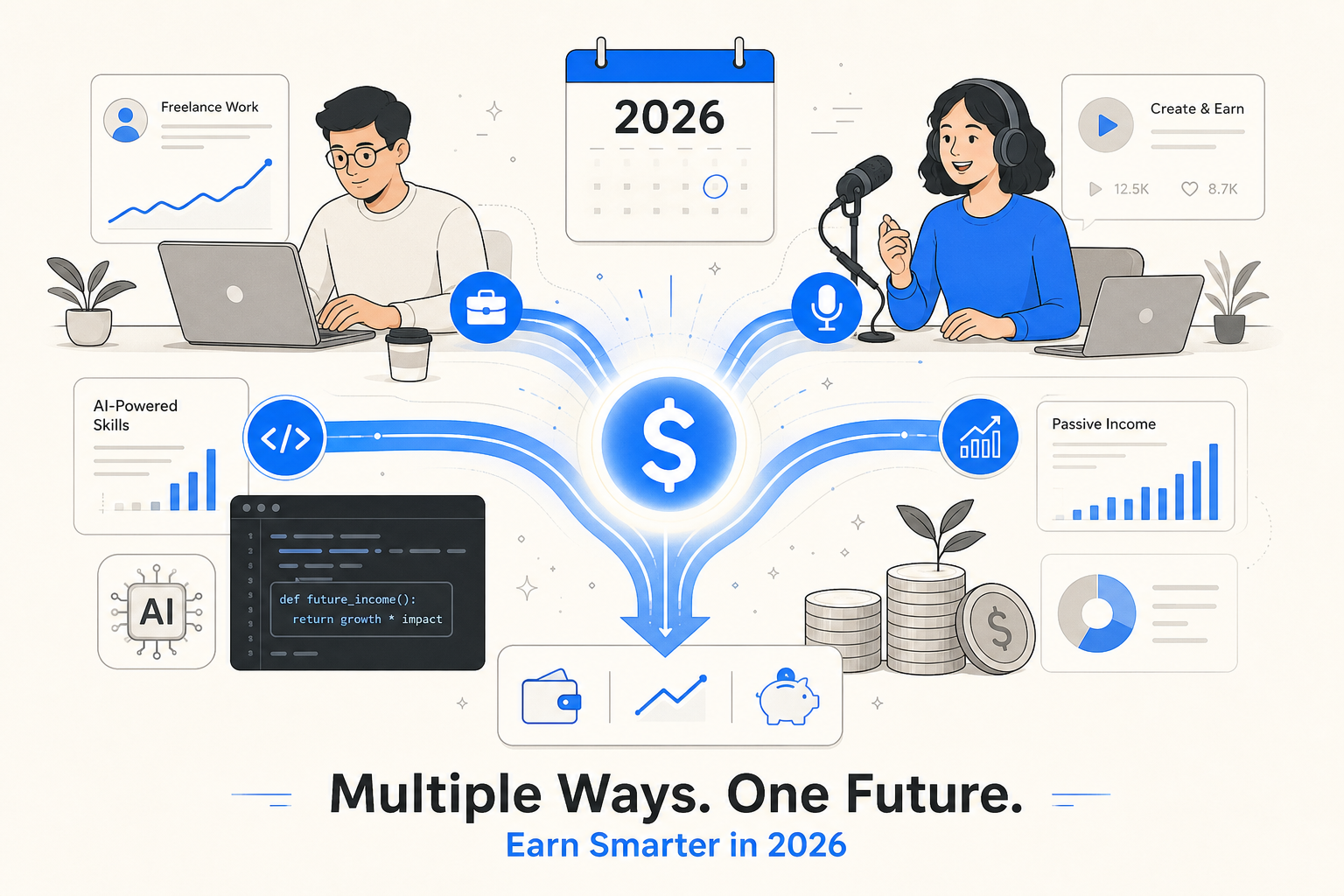
The gig economy has hit critical mass. AI skills command significant wage premiums. The creator economy is consolidating around multiple revenue streams. Here''s what actually works for earning in 2026.
The way people earn in 2026 has fundamentally shifted. 83 million Americans now freelance (48.5% of workforce by late 2026), with average freelancer income $99,230 — higher than the full-time baseline. AI skills fetch a 28–43% wage premium. 50 million creators are earning from content; 2 million earn six figures, but only if they build diversified revenue streams beyond single platforms.
The five dominant paths: (1) Freelance/gig work, (2) AI-enabled services, (3) Creator economy, (4) Passive income, (5) Traditional employment with AI skills. Most high earners ($100K+) combine at least two. The trend: away from single-employer dependency toward portfolio income and autonomy.
1. Freelance & gig work — the new mainstream
Freelancing has crossed from "side hustle" to "primary income" for the majority. 83 million Americans now work as independent contractors — roughly 25% of the workforce today, trending toward 48.5% by late 2026.
The numbers
Income. The average freelancer earns $99,230 annually — higher than the typical full-time baseline of $80,116. That extra $19K isn''t a side benefit; it''s structural. Freelancers command premium rates because:
- They carry their own benefits burden
- They deliver faster (no internal politics, approval chains, meetings)
- Clients pay for specialization
High earners. 4.7 million independent workers earned over $100K in 2024, up from 3 million in 2020 — a 57% increase in two years.
Generational shift. 43% of Gen Z now works in the gig economy — the highest adoption rate of any generation. Millennials (34%) and Gen X (35%) follow, while Boomers (19%) remain the holdouts.
Why the shift
72% of gig workers cite work-life balance as their primary motivation. Close behind: 62% want to choose their own hours, and 49% want to be their own boss. This isn''t about squeezing more money from fewer hours — it''s about autonomy.
63% prefer a portfolio of multiple clients over a single employer. Concentration risk is real; spreading dependency across 3–5 clients feels safer.
The tradeoff
60% satisfaction with flexibility, but 45% cite income instability as a concern. Mitigation strategies common in 2026:
- Retainer contracts (recurring revenue)
- Maintaining 3–5 steady clients to smooth variation
- Seasonal planning
- Building passive income streams as a buffer
2. AI-enabled earning — the wage premium
Workers with AI skills earn 28% more than comparable non-AI roles. Multiple AI skills push the premium to 43%. This is the fastest-growing income lever in 2026.
Tier 1: Using AI tools
A $50,000 freelancer using AI writing tools, code generation (Copilot), or design AI can see 20–50% productivity gains — $10K–$25K additional annual income from the same time investment, or charging clients 20–30% premium for faster delivery. 60% of freelancers are expected to use AI-driven platforms by year-end 2026.
Tier 2: Implementing AI solutions
The sweet spot in 2026 — high demand, moderate supply, real client value.
- Custom chatbot development: $40–$100/hour → $5K–$25K per project
- AI workflow automation: $3K–$8K per project
- Lead-generation systems: $3K–$10K/month for comprehensive systems
- Ongoing support: $2.5K–$15K/month
Specialization multiplier. Domain expertise + AI skills = 2–3x generalist rates. A healthcare AI specialist can charge $40K–$80K upfront + $3K–$6K monthly. Market momentum: 60% year-over-year increase in AI-related freelance projects.
Tier 3: Building AI/ML
- ML engineers: $150K–$300K+ annually
- AI/ML engineers average: $170,768
- Chief AI officers: $351K–$643K at top firms
- Freelance specialists: $500–$2K+ per hour for custom model work
Why AI earning is accelerating
78% of organizations now use AI in at least one function. Wages rise 2x faster in industries most exposed to AI. Supply of qualified AI talent is scarcest through 2027–2028, creating premium pricing power. No formal credentials required — entry is portfolio + demonstrable skills.
3. Creator economy — building to six figures
50 million creators are generating income from content. 2 million earn six figures — roughly 1% of the creator population. Achievable, but not obvious.
From platform payouts to owned revenue
The dominant trend in 2026: creators moving away from single-platform dependency toward diversified, owned revenue streams. Platform algorithm changes tank income overnight. YouTube/TikTok/Instagram take 30–50% of revenue. Creators don''t own the audience relationship; the platform does.
The 2026 creator structure:
- Platform audience (TikTok, YouTube, Instagram): 20–30% of income
- Owned community (Substack, Circle, Discord, email): 30–40%
- Digital products (courses, templates, books): 20–30%
- Sponsorships (500K+ audience): 10–20%
- Other (affiliate, licensing, events): 10–20%
A creator with 1M TikTok followers might earn $20K–$30K/year from platform payouts. Build a 10K-person paid community at $10–$20/month = $1.2M–$2.4M annually. Sell 2–3 courses = $50K–$200K. One sponsorship deal = $10K–$50K. 88% of community builders now monetize directly — professionalization is the price of reaching six figures.
4. Passive income & digital products
The least sexy path, with real earnings potential.
- Digital products: $500–$5K+/month per product (courses, templates, ebooks, design assets, code libraries)
- Content sites (SEO): Moderate earnings with strong organic traffic; requires 12+ months to build momentum
- Affiliate marketing: 5–15% of revenue for established audiences with real recommendations
- Dividend stocks/ETFs: Low-risk, modest returns ($500–$2K/month on $100K–$500K invested)
- Print-on-demand & niche SaaS: Moderate but sustainable returns
The common thread: all require upfront work before generating meaningful passive income. Runway: 6–12 months minimum.
5. Traditional employment with AI skills
Don''t sleep on employment. AI skills fetch a 28–43% wage premium even in traditional roles. A software engineer at a Fortune 500 without AI skills might earn $150K. With AI/ML specialization? $190K–$210K. Plus salary, benefits, equity, and AI signing bonuses ($10K–$50K).
Path selection guide
| Path | Barrier | Time to $50K | Time to $100K+ | Stability | Autonomy |
|---|---|---|---|---|---|
| Freelance/gig | Low | 1–2 years | 2–4 years | Moderate | High |
| AI-enabled (Tier 2) | Moderate | 1–2 years | 2–3 years | Moderate-High | High |
| Creator economy | Low | 2–3 years | 3–7 years | Low | High |
| Passive income | Low | 6–12mo runway | 3–5 years | High | High |
| Traditional + AI | Moderate | At hire | 1–2 years | High | Low |
Best positioning for 2026: combine paths. Full-time AI role ($80K–$120K) + Tier 2 implementation projects ($30K–$50K) + digital product ($10K–$20K) = $120K–$190K.
The trend lines
- Freelancing is mainstream. 50% of the US workforce will be fully or partially freelance by late 2026. Structural, not cyclical.
- AI creates an income multiplier. Any existing skillset gets a 20–50% productivity boost — instantly valuable.
- Creator economy requires professionalization. Hobbyists stay small; six-figure creators run real businesses.
- Specialization wins over virality. Domain expertise + skill = premium pricing.
- Diversification is the new stability. Portfolio of 2–3 streams smooths volatility and increases total earnings.
- Early movers capture premium rates. 2024–2027: AI skill scarcity = premium pricing. 2028+: commoditization compresses margins.
FAQ
Which way of earning has the lowest barrier to entry in 2026?
Using AI tools to boost your existing skills (Tier 1). A writer, designer, or developer can layer AI on top of current work for 20–50% productivity gains. No formal credentials required.
Can I combine multiple earning methods at once?
Yes — the highest earners do. Common structure: full-time AI-enabled job ($80K–$120K) + Tier 2 implementation contracts ($30K–$50K) + digital product sales ($10K–$30K) = $120K–$200K+ annually.
What''s the realistic timeline to six figures?
Freelance: 2–4 years with specialization. Creator economy: 3–7 years. AI implementation: 1–2 years with technical skills. Traditional employment with AI skills: already above-baseline at hire.
How do I choose between freelancing and building a creator business?
Freelancing: direct client relationships, steady recurring income, constant selling. Creator economy: owned audience, multiple revenue streams, compound growth, but 12–24 months of content investment before meaningful income. Many do both.
Is the gig economy stable enough to rely on?
45% cite income instability as a concern, but 60% prioritize flexibility. Stability comes from retainer clients, a portfolio of 3–5 steady clients, seasonal planning, and a 3–6 month expense buffer.
Frequently Asked Questions
What is the fastest way to make money in 2026?
Selling a skill you already have. Freelance service work pays within weeks, while content, products, and investing take months to compound.
How much can a beginner realistically earn online in 2026?
Most people starting from zero land in the $300–$1,500/month range in the first six months of consistent work. Six-figure outcomes exist but usually follow years of skill and audience building.
Is AI making online income easier or harder?
Both. AI collapses the cost of producing average work, so average work earns less. It also lets one person deliver what used to take a small team, which raises the ceiling for anyone who pairs AI with real expertise.
Do I need money to start?
No for services and content. Yes for investing and most ecommerce. Start with the path that matches your current capital and time.
Which income path is most durable?
Assets — index funds, products, and audiences — because they keep paying after the work is done. Services pay best per hour but stop the moment you do.